
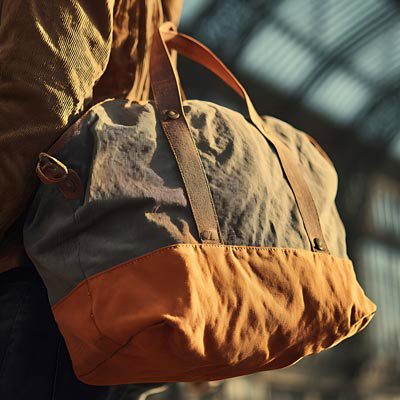
I met a traveler at a train station and he was carrying this very large bag. Too large to even fit on the train. It was three times the size that he was. It must have weighed 500 pounds. I don’t know how he had the strength to even carry it around and I couldn’t help myself. I said, “What’s in the bag?” He said, “Oh, this is my bag of questions.” I said, “Questions?” He said, “Yes, I have a lot of questions.” I said, “What kind of questions?”
He said, “Questions like, Why do some people cut every corner and ignore every opportunity to offer kindness? And still succeed. And why do some people suffer at no fault of their own? And why do people seem to make the same mistakes over and over again? And why are some people born into situations that limit them, instead of nurture them? Questions about how to treat others, how to find God’s presence, how to pray, how to respond to heartache, how to discover purpose in our work, and how to parent our children. I have a whole lot of questions.”
I was starting to see why his bag was so large. Those are some big questions. And I realized. I have a bag of questions as well. I said, “Do you think we will ever find answers to all of these questions?” He said, “I don’t think so. But I have discovered that just asking them and paying attention to them is enough.” Just asking questions can inform how we live. Determine how we respond. And shape where we experience the presence of God.
And Jacob, Jacob had his bag of questions. Like, is Esau still gonna be mad about that whole birthright thing? And, what am I going to say when I see him? And, is reconciliation even possible? And as he was traveling to see Esau, he slept right there on the bank of the Jabbok River, which the name of the river in Hebrew sounds a good bit like Jacob’s name. It also sounds a lot like the word in Hebrew that means wrestle.
And all throughout the night, Jacob wrestled with God and wrestled with his questions. That he would not let either one of them go until God blessed him. And as they wrestled, his hip was dislocated. I can only imagine how painful that was. And afterwards, Jacob would walk forever with a limp, a permanent reminder of wrestling with God. And he calls that place Peniel, which means I saw God face to face. That after asking his questions and seeing God’s face, Jacob had been changed. In fact, his name was changed to Israel, which means to wrestle with God.
And we all have questions that we wrestle with. Questions that wake us up at 2 a.m. in the morning and will not let us sleep. Questions that grab us in a panic or questions that are that chronic worry that we’re always carrying around. Questions where the answers are elusive and we cannot put them down.
And the psalmist seems to put words to Jacob’s experience that as he wrestled with God we can almost hear Jacob say, “Call upon you for you will answer me, O God. Incline your ear to me, hear my words, wondrously show your steadfast love, O Savior, of those who take refuge from their adversaries at your right hand. And we too have echoed those words. I call upon you. Show me your steadfast love. May I see your face.”
And Jacob would not let go of God until God blessed him. But this blessing was not necessarily clear answers. To all of his questions, was something more profound. That Jacob experienced the presence of the living God. And all of those questions that change us remind us that we have more to learn.
It was the same with Nicodemus. Remember Nicodemus, that teacher and expert in the law. Richard Lischer, who taught at Duke Divinity School, remembers that one of his colleagues just across the hallway had this cartoon from the New Yorker on his office door. A reminder to all of those very smart and studied people that maybe they didn’t know everything.
That the cartoon was of this commencement speaker, an alumni, someone very distinguished standing at the podium. With his cap and gown, and in that thought bubble over the speaker’s head, it said, “I don’t know where to begin because I know so much.”
It was the same challenge for Nicodemus. It had been so long since he had been surprised by grace. So long since he brushed up against the Spirit of God in new ways. So long since he had been taken aback by God’s steadfast love. And perhaps that’s why Jesus pointed him in the direction of being surprised and disoriented to see things new, to be born again.
That’s why Nicodemus started to ask questions. How can anyone be born after having grown old? Learning that we always have more to experience and learn ourselves, opening ourselves up to be surprised by grace. And it’s why we carry around our questions. Making room for something new.
One of the local gifts here in Auburn at the Jule Collins Smith Museum of Fine Art, just a few miles down the road, is the Amber Luster Chandelier by Dale Chihuly. That you stand there looking up and it is so beautiful. This bright amber yellow with flashes of color all through it.
Chihuly is an internationally known artist. He’s a glass blower making these large sculptures. In fact, one of his largest was in Jerusalem in 1999 where over a million people came to visit. And I watched this documentary of Chihuly blowing glass that he creates all these small pieces and then along with his team, they put these large sculptures together piece by piece.
And most of the time, sculptures are symmetrical. You can draw a line straight down the middle, and it’s like this mirror image. This side looks exactly like that side, that there’s beauty in symmetry. Chihuly did the opposite. He made room for something new. He saw beauty in asymmetry.
And life oftentimes is not symmetric. It does not unfold in ways that we expect. Is why we have so many questions. But an asymmetrical life is beautiful. Because we can experience the presence of the living God in our question. Just like Jacob did beside the river.
And like Jacob, walking with a limp, we, too, are changed. We are changed in ways that are lasting, hopeful, and full of grace. Amen.