
Like everybody else who’s here this morning, I had two grandmothers, but unlike many people in our transient society today, I lived in relatively close proximity to both of them throughout my childhood. One grandmother lived only a few miles away, just across town. The other one, about 20 miles out in the country. Both were within shouting distance, courtesy of South Central Bell.
My grandmothers could not have been more different. My maternal grandmother was the oldest of five, three sisters, one brother. Her mother, my great grandmother, was an invalid for more than 20 years and my grandmother took care of her every day, feeding her and dressing her, bathing her and braiding her long white hair. My grandmother was married to my grandfather for almost 50 years. He died one week before their golden wedding anniversary. Together they had two daughters and my mother is their younger child.
My grandmother was a stately woman. The brief announcement of their wedding, which we found only after she died, noted that the bride was handsome in her brown wedding suit. She was strong and tall, a large woman, always properly groomed except when gardening. She favored well-made clothes and she enjoyed nice things. She lived in a white-framed house on a couple of acres. There was room for a few chickens and maybe a calf or two, always enough to keep our family well-fed. My grandparents had a large garden and my grandmother grew beautiful flowers which she sold often to local florists. And she lived on Charity Lane. Isn’t that the perfect address for a southern grandmother? All she needed was a white picket fence.
We had Sunday lunch at her house almost every week. She cooked for as many members of our extended family as she could round up, the more the better. She loved being the matriarch. I cannot remember a Sunday meal at her house when she sat down with us at the beginning of the meal. She fussed and served and refilled and offered seconds, a loving but somewhat bothersome presence. She hovered. And when there was a large group of family in attendance, children ate in the kitchen, young adults in the living room at folding tables, and older adults got one of those prized seats in the dining room. There were definite distinctions about who belonged where.
My grandmother had a sister who went to India as a single missionary. She met and married a mixed-race medical doctor and they happily served in India together for more than 40 years. She came home on furlough, but she never brought her husband. Alabama in the 1960s and 70s was not a place for a white woman to be seen with a man of color. I saw my grandmother read and study about India so that she would know where her sister was, what the culture was, what the needs were. And I watched her write carefully on that beautiful, thin, blue airmail stationery, weekly letters of family news, keeping her sister up to date and connected to home. I also saw my grandmother deflect questions about her brother-in-law from folks outside our family. And I heard her comments about that brother-in-law to folks inside the family. My grandmother respected her sister’s choices, but she appreciated her sister’s discretion.
My paternal grandmother could not have been more different. She was the youngest of eight. Only one of her other siblings was born of the same set of parents. She had brothers and sisters who shared one parent or the other, but only Cora was her full sister. And together they had an unstable childhood with lots of moving and shifting of family situations. In her early 20s, she married a divorced man who had children from a previous marriage. And together they had five sons in their 27 years together. She lost her middle son to spinal meningitis when he was only five years old, just one month before she birthed her fifth son, my father. She was widowed at 49 and she never remarried.
In my memory, she was always old, but I am the youngest child’s youngest child. And so when I knew her, she had already been a grandmother for many years. She was a tiny woman, never more than a hundred pounds her whole life. She was slight of frame, but sharp of tongue. She always wore a dress, an apron, and a hairnet. She took off the apron to go to church, but she did not take off the hairnet. And in spite of that almost ever present apron, I do not ever remember eating a meal in her house. She had a small home in the middle of Huntsville and she often took in boarders, but she only provided space, not food.
And as a small child, I knew that she preferred the boys. Girls were merely tolerated. She made quilts for each of her grandsons, none for her granddaughters. It was sometimes unpleasant for me to be left in her care, but she was a regular babysitter for any number of children, including my brother and me. And as a little child, I did very little that she appreciated, almost nothing that was right in her eyes. Fortunately, that changed as I grew up. She loved to go riding in my yellow Mustang, and I took her and her friends to dinner and to go shopping. And then I married the preacher boy she had always wanted in her family, and I gave birth to two boys. But even before those boys in my life rescued me, my grandmother and I had grown to love each other in our own ways, but it was difficult.
These two women were fixtures in my life. I saw both of them every week, talked to both of them almost every day for the first 17 years of my life. What did I learn from them? First, let me say that both of my grandmothers were faithful church women, one to the Baptist church where I grew up and one to the Methodist church where my mother grew up and where my parents were married.
From my mother’s mother, I learned to love flowers and fine china and good food and conversation and books. I have her glass front bookcase in my bedroom, in Gatlinburg in that little stationery box where she kept that airmail stationery. I learned from her the importance of caring for others, even when it means great personal sacrifice. And from my father’s mother, I learned to laugh. She was incredibly funny, to see things with a critical eye, but to appreciate camaraderie and to empathize with the outsider. From her I learned that it is okay to be alone.
And from both of them, whether they wanted me to or not, I learned that some people belong and some people don’t. I learned that there are distinctions, real ones and imaginary ones, and that some people will always be them and not us. Unfortunately, I learned that those others are often to be suspected and feared, not respected and welcomed. All of us, I suppose, have to sift through the lessons from the ones who have come before us. And I’ve tried to find the good lessons from my grandmothers and to forget what needs to be left behind. To choose the good, to try to find the better option, even when more than one choice might be good. I’ve tried to open my mind and my home to others, and I have struggled to calm and remove those childhood fears.
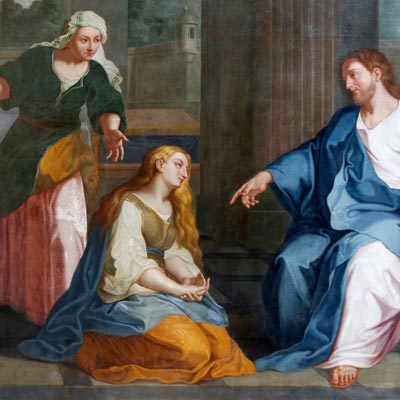
In Luke chapter 10, we read the story of two women who are very different in temperament and behavior and who just happen to be sisters. I’m not going to read the text to you today because we know that story. Mary and Martha are the biblical characters that most women most easily identify with today. From the several times that we encounter them in scripture, we learn that Martha is bold, and outspoken while Mary is more emotional and thoughtful. These sisters, along with their brother Lazarus, appear to be among Jesus’ closest friends, folks with whom Jesus could just be himself.
I have a little calligraphy plaque at home that reads, need to have people who mean something to us, people we can turn to so that being with them is like coming home. I think that’s what it felt like for Jesus to be with Mary and Martha and Lazarus. And this little story, just five verses, is sandwiched between two significant Bible stories which we also know. The parable of the good Samaritan, which begins with two important questions. What must I do to inherit eternal life? And who is my neighbor? That comes before Mary and Martha, and after Mary and Martha, Luke teaches the disciples how to pray.
In just a couple of chapters, Luke has shared a wealth of Jesus’ teaching along the way, sending out the 72, two by two, to prepare for Jesus and the disciples to continue their journeys. So he arrives with an entourage of untold size. While he sits to rest comfortable in the home of his dear friends, folks gathered near him, pulling up their chairs, sitting by his feet, perhaps propping on the arm of a friend’s chair.
Luke tells us that a woman named Martha opened her home to him. It’s not clear if she’s the matriarch of this little family, since she’s really not even usually listed first. It’s usually Mary and Martha. And Luke also doesn’t give credit to Lazarus, her brother, as the homeowner. This is Martha’s home. So how would you have felt knowing that Jesus was coming, that you had extended this invitation, and that crowds would follow? Most of us, I suspect, would have responded just as Martha did, cleaning and straightening, cooking and preparing foods ahead of time, maybe making Jesus’ favorite meals.
Martha had probably been working for days. I suspect that she took great pride in having the tidiest home, the freshest bread, the most mouthwatering mutton. And hear me clearly, there is nothing wrong with that. Martha was a doer. She wanted the people who entered her home to feel comfortable and clean, to be refreshed and renewed. And she did the part that she knew to do to make that so.
Let me paint a little scene for you. Imagine that Martha is busy in the kitchen. She brushes aside a wisp of her hair and peers through a curtain dividing the two or three large rooms in her home. The curtain blown aside by the afternoon wind. And she catches a glimpse of Jesus. Comfortable and relaxed, and it made her smile. She felt good about her busyness and her preparations. But her smile fades with a second gust of wind as she sees her sister Mary sitting right there at Jesus feet. She’s exasperated, frustrated, tired, just plain angry.
Martha had determined her proper place and Mary’s based on responsibility and probably gender. She doesn’t express any animosity toward her brother. And Luke tells us that she asks Jesus to intervene, to get Mary up and out, to help her when there’s so much work to be done. And we can relate to this moment, can’t we? We know the frustration of feeling like we’re the only one who’s busy, the only one who’s committed, the only one who’s working and feeling like others are taking advantage of our efforts and our abilities. It’s human nature to see ourselves in this situation and others like it and to respond just as Martha did.
But let’s stop and remember where this little story takes place. Between those other two well-known gospel stories and that important first question from the expert in the law, what must I do to inherit eternal life? It’s the wrong question. Inheritance is not a matter of doing, it’s a matter of being. It’s who you are that counts, not what you do. Doing isn’t wrong, but it’s not the main thing to which Christ calls us. Christ calls us to be, to be His, His followers, His servants, His hands, His feet, His people. But often, being those things moves us into busyness. There are lots of things that we need to do, but first, like Mary, we need to sit at the feet of Jesus.
And we need to be humble enough to stop what we’re doing that we think is so important and find the time to be. Even now as we move into our break for the summer, our lives don’t really feel like they’re slowing down. Just this month we’ve had graduations and Mother’s Day. We have Memorial Day and end of school activities. These days require lots of busyness for most of us. So I think it’s helpful to take time for being, to be quiet, to remember, to recognize our blessings, to pray and to reflect daily on who God wants us to be, to practice thankfulness, to reach out to others, especially those who experience loss or loneliness.
And even in this intentional quieting of our lives, it can easily morph into more activity. It is a hard act to balance. But being is the life source for all of the doing. It is the bedrock, the foundation, the sustenance. If our hands are too busy, too full of the stuff of our lives, even if it’s the good stuff, caring for others, making necessary preparations, working efficiently and effectively to do the things we’re asked to do, if our hands are full, we need to empty them so that we can take the hand of the one who would lead us.
And even in this, Christ is our example. Philippians 2 tells us that Christ emptied himself and became the sacrifice for us all. And I think of my grandmothers, one of them with her apron on, cleaning the face of a child or wiping away a tear. And the other one who took a basin every day to minister to her mother. They knew what it meant to serve, and they knew how to do all of those things that they were expected to do, serving like Martha.
But each of them, not maliciously or with any evil intent, each of them excluded others. They drew lines, and they lived with strictly defined parameters. So let’s not forget that first question. What must I do? The expert who questioned Jesus answered with what was written in the law. Love the Lord your God with all your heart and with all your soul and with all your strength and with all your mind and love your neighbor as yourself. You are correct, Jesus says to him. And then Luke adds this about the law follower who he says, wants to justify himself. He asked the second important question, who is my neighbor?
In telling the parable of the good Samaritan, Jesus redefined parameters and broke down the barriers. And then he taught the disciples to pray. Thy will be done, not mine. Give us, plural, us, it’s all of us, our daily bread, not more than we need lest someone else should go hungry, but what each person needs, all of us and each of us. Forgive us as we forgive others. Now that we know who our neighbor is, Christ teaches us to pray for all, our church, our community, our world.
Following Christ, being his hands, his feet, his child is an individual journey in the midst of community. We are not alone in this pilgrimage of faith. We walk hand in hand, side by side with people who look like us and act like us, and with people who look nothing like us and act nothing like us. And that’s the beauty of Christ’s call to be his.
Jesus says Mary has chosen the better way and it shall not be taken from her. Busy people that we are, Christ calls us to sit at his feet. And he gives us permission to sit, to refrain, to stop being busy. And he reminds us if we read the whole story, that there is a place for every person regardless of age or gender or any other dividing line. No distinctions. There is room at the table for everyone.
Galatians 3:28 tells us this, there is neither Jew nor Greek, slave nor free, male nor female, for you are all one in Christ Jesus. We are called to be and to do, not one without the other. Experience God’s love and do good. Be Christ’s people and include everyone however you can, whenever you can, wherever you can, for as long as you can. May it ever be so. Amen.