
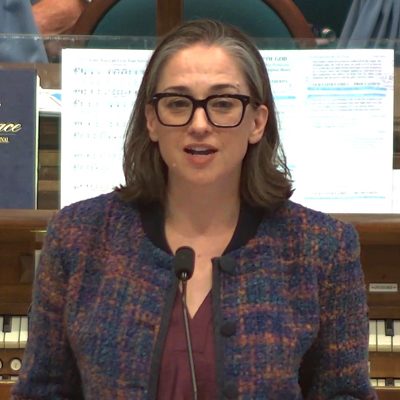
Also watch the 2026 Claude H. and Mary Virginia Moore lecture:
Good morning. Thank you to Pastor Martin for the invitation to be with you today. Thank you all for your good hospitality. Let us pray.
Bless the Lord, O my soul. God, you stretch out the heavens like a tent. You water the earth with your rain. May my meditation be pleasing to God, for I rejoice in the Lord. Bless the Lord, O my soul. Amen.
I’m delighted to be here with you this morning. When Pastor Martin asked me to join you to think about the Bible and ecology, I was quite encouraged. A Pew Research Center report from 2022 finds that most people who are religious will never in their life hear a sermon or a teaching on climate change or the environment. Most people of faith in their lives will never hear a sermon or a teaching about climate change or the environment. Friends, we have a lot of work to do. So I was encouraged to hear that you’re already starting to think about this good work in your community. And our work is only beginning.
I have the great privilege of teaching young faith leaders at Princeton Theological Seminary. Last year I taught a course on ecology in the Bible. In that class we learned about ancient agriculture, about ancient water systems, biblical ideas of wilderness. We also learned about our many environmental crises around the world and spent a good amount of time discussing biblical texts. I’m a scholar of the Old Testament, so I admit we spend a lot of time talking about the stories and especially the poems of the Hebrew Bible. How do these ancient words that come to us from so many thousands of years ago help us to understand ourselves, our world, our God, and our ecological responsibilities?
One of the poems that we read in class was the one we just heard read so beautifully this morning, Psalm 104: “Bless the Lord, O my soul. O Lord my God, you are very great. You are clothed in honor and majesty, wrapped in light as in a garment. You stretch out the heavens like a tent. You set the beams of your chambers on the waters. You make the clouds your chariot. You ride on the wings of the wind.” This is its refrain: “Bless the Lord, O my soul. We can say it all together, in fact. Bless the Lord, O my soul.”
So during this class on Bible and ecology, I was asked to participate in a chapel service at the seminary tied to the themes of my class. I was just delighted by this. So terrific, I said. I would like the chapel service to be about water, which was one of the themes we had been talking about. So the wonderful chapel staff came back to me with a plan for the service. And here are some of the things that were in that plan.
“My soul thirsts for you,” the service said. “Let all who are thirsty come,” the service said, “and receive the water of life.” “Help us to become fountains of your living water,” the service said, “showing your love and kindness to others in the midst of a dry and weary world.” And the scripture lesson from the Gospel of John said this: “Let anyone who is thirsty come to me and let the one who believes in me drink.” As the scripture has said, “Out of the believer’s heart shall flow rivers of living water.”
Do you catch the theme here? In every single one of these examples, water is a metaphor for spiritual life. The metaphor teaches us that our thirsty souls are nourished by spiritual water that comes from God. Our thirsty souls are nourished by living water that comes from God. Well, this is a beautiful message. Please remember that our souls are indeed nourished by the living water that comes from God. Bless the Lord, O my soul.
But I wanted to talk about actual water. Water that falls from the tap when we turn it on. Water that we bathe our aching, smelly bodies in. Water that we feel on our face when we forget an umbrella. Water we splash in when we go to a pool or to a lake. Water that we drink every single day of our lives or else we die. Water that miraculously falls from the sky. It might even cause a rain delay now and again.
Where does your water come from? This is one of the most important questions that you can ask yourself as a person of faith. Where does your water come from? What journey has your water taken before it comes to your tap, before it comes to your hose, to your water bottle? Where does your water come from?
Because among the many crises that we face today globally, some of the most pressing are crises of water. Fresh water, drinking water, water that’s clean enough for farming is in rapidly decreasing supply. When the Old Testament texts talk about living water, and they do often, this is what they mean. Hebrew calls it mayim chayim . It’s lovely, it sounds good, right? mayim chayim , living water. In the Hebrew, living water does not mean spiritual water. It means water that is flowing and bubbling, a spring whose water is oxygenated and clean. Living water is fresh water. It is water you can drink. Every time you turn on your tap, you are receiving mayim chayim , living water. Every time you wash your hands, you are bathing in mayim chayim , in living water. Every time you take a sip of water, you are drinking mayim chayim, living water.
Where does your living water come from? Well, the psalmist asks themselves that same question and gives us a gorgeous answer in the shape of this poem, Psalm 104. Listen again to the words of this ancient poem: “You, O God, cover the earth with deep waters as with a garment. You make springs gush forth in the valleys. They flow between the hills. You give drink to every wild animal. The wild asses quench their thirst. By the streams the birds of the air have their habitation. They sing among the branches. From your lofty abode you water the mountains, and the earth is satisfied with the fruit of your work.”
Where does our water come from? The psalmist answers: from God. From God who rides on the clouds, whose house is on high, who has established the heavens, who makes the waters course and cycle. Bless the Lord, O my soul.
The earth is miraculously full of water. Science confirms for us both the rarity of water and its necessity to sustain life. Earth is a miraculous habitat because of water. Of course, the psalmist isn’t thinking about science, but the psalmist is thinking about how to live. And how to live for the psalmist means seeing this miracle of water and praising God. We are dependent on water that we did not make. That makes us, along with every wild animal, the wild asses, the birds of the air, the land itself, all of us alike, creatures dependent on God who provides us with living water. Even the trees, the psalmist tells us, the trees of the Lord are watered abundantly, the cedars of Lebanon that God planted. What a beautiful image, God planting the trees and watering them. Bless the Lord, O my soul.
We tend to spiritualize water in the Christian tradition, but the richness of the spiritual metaphor can only be understood when we understand the gift of actual water, real water, living water, water that God gives the whole world every day. This is why we baptize with water and understand it as the gift of the Holy Spirit. How can we be grateful for God’s love without being grateful for God’s water that gives us our very lives? We cannot separate these two gifts.
So like the psalmist does, we too must ask, where does our water come from? What do we know about our local watersheds? I live in the Stony Brook-Millstone Watershed in New Jersey, and I drink water from a well that is fed by these waters. What happens to water in Lee County? What happens in the Alabama River basin? I’m asking honest questions because I don’t know, I’m not from here. But perhaps you do, or perhaps you might learn. When rain falls on the land where you live, where does it go? What streams and rivers does it feed? What aquifers hold ancient living water under our feet? How are we tapping those non-renewable resources?
One thing to think about is our very local, increasingly urgent question of how we are directing rainwater. That’s a question church communities should really care about. What happens to rainwater when it falls? Climate change is leading to increasingly violent storms and floods. We remember and pray for the people of Nepal and around the world experiencing catastrophic flooding right now. In the state of New Jersey, we tend to pave a lot of things. This is where I’m from. We pave our roads, our parking lots, our sidewalks, our driveways, which means that rainwater is channeled away from the topsoil. Without porous land to soak it up and slow its progress, we end up with dangerous torrents. Increased paving and impervious surfaces leads to increased pollution and increased flooding, which puts communities at risk. Churches can act on these things.
But we must also expand our scope. We’re living in a time of global freshwater crises. We are losing our living water, our fresh, clean water at an enormous rate, especially through industrial agriculture. We’re producing food on a massive scale and draining aquifers to water farms that are thirsty for more water than the rain can provide. So we are losing fresh water.
The psalmist says, “Every creature looks to you to give them their food in due season. When you give it to them, they gather it up. When you open your hand, they are filled with good things.” Water, every drop of living water belongs to God. It is God’s gift of life to us. But it is not God’s gift to us alone. It is God’s gift to every living being, every creature that moves on this earth, every bird, every wild ass, every coney, every puppy dog that lives in your house, every tree that grows, every fish that swims. This water, this fresh living water pours down from the sky by a miracle. By it, God gives food to every creature.
We cannot talk about food justice without talking about water justice. In places that are more vulnerable, the loss of fresh water is felt with greater devastation. For example, part of the ongoing crisis in Gaza is a lack of access to fresh water. This is not a new crisis that is the result of the current war, though it is also worsened by that too. This is a decades- and centuries-long crisis about access to fresh water in the region. In the Gaza Strip, which has no surface water, 96 percent of the water is unfit for consumption by UN standards. There is literally no living water. Fresh water there must be purchased from a small number of privately operated desalination plants. Access to fresh water, to living water, is the single most important way that people will be affected by climate change. We should start paying attention now. To care about water is to care about justice. To care about people is to care about water.
Friends, these problems are complex and enormous. I don’t mean to pretend that they are not, but I don’t want to overwhelm you with them. It is what it is. They’re complex and they are enormous. Being people of faith does not get us a free pass out of complex and enormous problems. Being people of faith gives us the courage and strength to face complex and enormous problems. Being people of faith gives us the courage and strength to face them.
So how can we start? Well, it’s simple. Start by paying attention. Pay attention when you turn on your tap. Ask, where does our water come from? When you feel that living water spilling over your hands, stop and pray. Say to God, in whatever words you want to use, this water is yours, God. It is not ours. Thank you.
Start by paying attention when you take a drink of water. Ask, where does our water come from? When you feel that living water in your mouth, stop and pray. Say to God in whatever words you want to use, this water is yours, God, it is not ours. Thank you.
Start by paying attention when you eat your supper today. Ask, where did the water come from that fed the wheat that made this bread, that watered this lettuce, that gave drink to the cow who produced the milk that made this butter? Say to God in whatever words you want to use, this water is yours, God. It is not ours. Thank you.
Start by starting a conversation. Talk to your neighbors, your fellow community members, your church elders, your political representatives. Ask them, where does our water come from? What do we need to do to be ministers and stewards of this great miracle that comes to us as a gift? Who is thirsty in our community? Who needs access to real, fresh, clean, drinkable, living water? How can we give them drink?
The first steps are simple. Today you can pray. Today you can set up a bird bath. Tomorrow you might set up a rain barrel. Then maybe you can find a way to volunteer, to join a committee, to read a book, to learn more, to support local farmers and sustainable agriculture. Maybe soon you can find a small window in your busy life to visit the stream nearest to where you live. In that small act, standing beside a body of water, we might be reminded how great is this miracle by which we live. In this small act, standing next to a body of water, we might start to understand why the psalmist says over and over and over: Bless the Lord, O my soul. Amen.