
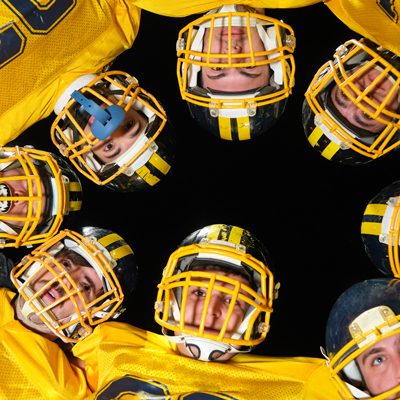
Thomas Fuller writes for the first page of the New York Times. But in 2021, he moved to California to immerse himself in a story about the eight-man football team at the California School for the Deaf at Riverside. That they played not only other schools for the deaf, but also hearing schools. And eight-man football is a big deal in California, but they had suffered many long seasons of defeat. They were now quickly on the rise.
In the first game he ever attended at the California School for the Deaf, he left with this initial impression: the lack of noise. There was no loudspeaker. They didn’t announce the names of the captains before kickoff. They didn’t play music in between the plays. Instead, it was all of these quiet, signed conversations in the bleachers. And they won the state championship in 2022. It made national headlines, but it was more than just a story about winning a championship. It was more than a story about overcoming great odds. It was a story about belonging, commitment, and community because they shared far more than just footages.
A little-known fact is that the huddle, where the offense huddles up before each play, was invented in 1894 at Gallaudet University, which is a university for the deaf. They started to huddle up before each play so the defense could not see their signed conversation. Gallaudet is the home of the huddle.
And when the school at Riverside won its semifinal game before going to the state championship, they had just beat a hearing team and a journalist stopped the coach from the other team after the game to ask him a question and the coach said, would say be careful in thinking that you have an advantage. They communicate better than any team I have ever coached against. It reminds us of that proverb, if you want to go fast, go alone. If you want to go far, go together.
And the letter of 1 Peter describes the church for early congregations under persecution, that they are under constant duress, questioning whether it is all worth it. And this letter reminds them that they are living stones fashioned together by God. It goes on to say that the church is a chosen race, a royal priesthood, a holy nation, all of which is meant to prop up a people who are pushed down. That under different circumstances, those same titles could fuel privilege and pride. So for us today as living stones, our identity is rooted in becoming the body of Christ where God is the grand architect, fashioning together the living stones, as it says in 1 Peter, for us to become the hands and feet of Christ, not superior to others, but serving them.
It is as Drew Holcomb sings, you gotta find your people, the ones who make you feel whole. Because we are transformed by one another. And this story about Saul and Stephen demonstrates this transformation where Stephen is the first martyr of the church and Saul, later known as Paul, was there on the day of this terrible tragedy. That Saul and others were seeking out and trying to uncover followers of Jesus and Stephen was guilty as charged. And when the crowd stoned him, Stephen echoes those words that we hear Jesus say on the cross, Lord, do not hold this sin against them.
This was not the flashing light on the way to Damascus. This is not when Saul heard the voice of Christ, but the voice of Stephen echoing those words of forgiveness. Perhaps they seeped down into Saul’s life so that when he was on his way to Damascus, a door was open where he could see and hear something different. Because Saul stood in a place of harm and hate, where Paul would stand in a place of hope and healing. That when Saul became Paul, fashioned together as the body of Christ, he spent the rest of his life as the apostle to the Gentiles expanding community instead of restricting, which was quite the building project.
And one of the most significant architectural achievements of the Renaissance is undoubtedly the dome over the Florence Cathedral in Italy. The original plan was to take the statue of David by Michelangelo and put it up on top of the dome. But when the Catholic Church saw David’s wardrobe, they decided on a more modest location. But the architect, Filippo Brunelleschi, was both an amateur and a genius. He created all these machines that had never been seen before in order to construct this dome, defying the engineering techniques of the day. There are five million bricks in the dome in a herringbone pattern and no mortar was used. It is a self-supporting structure, which is amazing because in the top of it is an oculus. There is a hole in the middle of the dome. And standing there, looking up at this structure, we are left with this breathless question.
And the church is left with a similar question. How can a group of people be fashioned together as the body of Christ? To be a people is to have a story. It’s what fashions us together. And when we tell our story, we might talk about looking down at that form that the school gives you at the beginning of the year and not having a name to put next to emergency contact for our child until we came to this place. Or as one church member did, just write down the church office phone number.
Or we might talk about standing up here on Youth Sunday and preaching or praying and then being celebrated by this congregation and it changing how we see ourselves. Or we might talk about that unplanned conversation that we fell into after the Sunday school lesson with someone who had already been down the path of grief, how that conversation unlocked a strength in us where we felt like we could travel it as well. Or we might talk about that joy that we stumbled upon in serving others, whether it was just handing out bags of snacks through the Auburn Sustenance Project or teaching children at Touching Miami with Love, where all of a sudden our world felt bigger and fuller. That our story is rooted in the love of Christ and in the grace of God that fashions us together as the body of Christ.
If you’ve ever tried out for the school play, you know that there is this jubilant camaraderie amongst all the cast members. Whether you’re out on stage or you’re working behind the curtain, there’s this wonderful bond that happens through all the performances and rehearsals, through telling the story together and participating in it. And Annie Dillard says that worship is like rehearsing a play. That we’ve been rehearsing this story and participating in it for thousands of years, and we’re still trying to work out all the kinks. That we don’t rehearse this story in order to get it perfect. We keep rehearsing it and participating in it to keep it at the forefront of our lives.
Because we have to be careful in how we tell our story. That our story is not about who we are not, that we’re not like this, we’re not like that, we’re certainly not like them. When we tell that kind of story, it’s usually born out of old wounds. But our story needs to say something, not just avoid something. And our story is also not about an enemy. We can’t define ourselves by who we are against. Our story must have a greater and fuller purpose. That our story is about what we are for. We are for humility and healing. We are for kindness and concern. We are for grace and generosity. We are for forgiveness and faith. We are for listening and love. That is our story.
And as Stanley Hauerwas says, we need to keep our story straight. Because as we rehearse it, as we participate in it, it changes us as we are fashioned together as the body of Christ. Amen.