
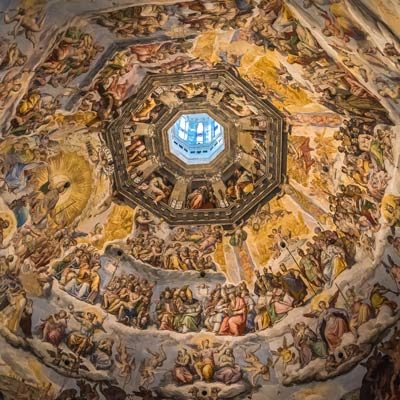
The cathedral in Florence, Italy, or the Duomo, known around the world, was begun in 1296, seven hundred and thirty years ago. The baptistry of this cathedral is where Dante was baptized.
Makes us feel rather young.
Auburn First Baptist is less than two hundred years old.
And the wealthiest family in Florence at the time was the House of Medici, found at the very center of the Renaissance movement. But the House of Medici did not pay to build this cathedral, nor did the Catholic Church.
The citizens in Florence came together and decided to tax themselves for a hundred and thirty-nine years in order to build this church.
The vision was heartfelt and hopeful, but also overwhelming.
But together, they made this commitment, which meant that most of the people giving to this venture would never see it completed, that they were a small part of a larger picture.
And when the people of God fled Egypt, they were part of something much larger than themselves. Moses stood up to Pharaoh. The people escaped, and they returned to where it all started, Mount Sinai, where Moses took off his sandals and stood before the burning bush, where Moses was called by God.
And now the people were called by God.
God called them back to that promise made to Abraham and Sarah, “I will be your God, and you will be my people.” That they were called to lean into the ways of God, marked by the Ten Commandments. “Do not worship other gods. Do not make idols. Do not misuse God’s name. Keep the Sabbath holy. Honor your parents. Do not murder. Do not commit adultery. Do not steal. Do not bear false witness. Do not covet.”
And right there, in the middle of the ten, is the fourth, and it holds the ten together. “Keep the Sabbath holy.”
Because God worked for six days and then rested.
And as we rest, we remember all that God has done.
And this was in stark contrast to the constant, never-ending work of Pharaoh.
As slaves to Pharaoh, they worked without rest. They labored without renewal. They produced without purpose. But now, on the Sabbath, the people had rest, and their work had purpose, because they recognized all that they had received instead of just what they had produced.
And Jesus has a similar message. In Second Corinthians and elsewhere, Jesus is described as the generosity of God. “For you know the generous act of our Lord Jesus Christ, that though he was rich, yet for your sakes he became poor, so that by his poverty you might become rich.”
When we imagine Jesus feeding the hungry, embracing the forgotten, healing the broken, we witness the generosity of God that we have received from God.
And we give out of what we have been given, whether that is mercy, forgiveness, patience, or firstfruits, that we are a small part of a larger picture.
And it’s why Paul started to list all of his many credentials, but then he tore up his resume.
That he’s a Hebrew of Hebrews. He’s from the tribe of Benjamin. He was a Pharisee. But he says, “All of this is a loss,” because his deepest gratitude was for the grace of God that he had received.
So we bring the wheat from our fields and the grapes from our vineyards, recognizing all that we have received, that our work and our gifts have purpose.
It is, as Wendell Berry says, “Plant sequoias.”
That we are to start work that we will never finish.
And like those mustard seeds, when a seed falls to the ground and begins to sprout, we would never imagine it would grow to be a sequoia a hundred and seventy feet tall.
But we’re a small part of this larger picture.
Rabbi Harold Kushner told a story about a friend of his who, every time he wrote a check—you remember when we wrote checks?—would write, “Thank you,” on the memo line.
Every check, whether it was at the dry cleaners, paying the power bill, buying baby formula, repairing an air conditioner, or helping others. Every check, “Thank you.”
It was a practice of gratitude.
And those things might seem rather small, but they are actually a part of planting sequoias.
Building a home, raising a family, fostering a community.
And we do those things as well.
Washing baptismal robes, paying the power bill, caring for the children of the church, repairing air conditioners, caring for the needs of the most vulnerable, planning celebrations, providing dinner for youth and college students. It is building a family of faith.
And today, we are invited to pause, to rest, and to reflect on all that we have received, as well as our financial support and regular commitment to this family of faith.
If you have been able to give regularly and you are able to increase that gift, I invite you to do so.
And if you have not been able to give regularly, but you are able to begin, I invite you to do so, for these things are important for this place.
Because together, we create a place for worship, music, gratitude.
We create a place for conversations, questions, and learning. We create a place to serve the needs of others beyond our own.
That together, we create a place where everyone is welcome, a place for children and young people, and a place where the grace of God can continue to shape our lives.
That together, we plant sequoias.
Amen.