
James Martin talks about all the jobs that he had before his vocation as a Jesuit priest. And it’s a long list. He was a busboy, dishwasher, golf caddy, movie usher, factory worker, bank teller, and an accountant.
And when he was a movie usher at the Plymouth Meeting Mall where all the teenagers used to hang out. He spent his days taking up tickets, reminding customers to whisper, and of course popping popcorn. Lots of popcorn. In fact, the staff would take turns. There was a small room in the back where you had to go to pop the popcorn and you spent all day, 10 hours straight. And it was quite warm in that room. And of course, it smelled like popcorn, which sounds like a good thing. But after 10 hours, thankfully, they could take a break every few hours when they were busy popping popcorn.
And on his lunch break he walked to the other end of the mall to get lunch at his favorite place, Roy Rogers. And he waited in this long line and the lady in front of him happened to know the lady behind him and they struck up a conversation. She turned around to the lady behind him and said, “Do you smell popcorn?” She said, “Yes, but the movie theater’s on the other end of the mall.” And the lady in the front said, “Yeah, and the smell is so strong. Maybe they sell popcorn at Roy Rogers.”
He was mortified. He had nowhere to hide. As soon as he could grab his order, he ran away. And we all know that feeling when too much of who we are feels exposed. And we worry that someone’s going to smell the popcorn on us.
But we have to be careful because there is this powerful connection between who we are and who God is. And it has long been recognized. In the year 400, Augustine wrote, “Grant, Lord, that I may know myself, that I may know thee.” Or in the 13th century, Meister Eckhart said, “None can know God who does not know himself or herself.” Or St. Teresa of Avila: “Almost all problems in the spiritual life stem from a lack of self-knowledge.”
There is this connection between who we are and who God is. And this connection surprised Peter. He had answered the question correctly. “Who do you say that I am? You are the Son of the living God” It’s a question about who God is.
But then Jesus said, road’s going to be difficult. Jesus was going to face suffering. And Peter knew the Messiah was to be the next king. Kings don’t suffer. They win victory. So Peter raised his hand again and he spoke up. “God forbid it.” He told Jesus, “Stop speaking that way.”
But this was a question about who Peter was. Peter wanted to follow a king, not a suffering servant. This question was about Peter, not Jesus. So Jesus said, “Whoever wants to follow me, deny themselves and take up a cross.” In order to save our life, we have to lose it. We discover who we are by leaning into who God is.
And this goes as far back as Moses. That before that fateful day of tending to his father-in-law’s sheep, no one would have thought that Moses would lead people. If anybody had credentials for leadership, it was his father-in-law Jethro, who was at least a priest. Nothing on Moses’s LinkedIn page pointed to leadership.
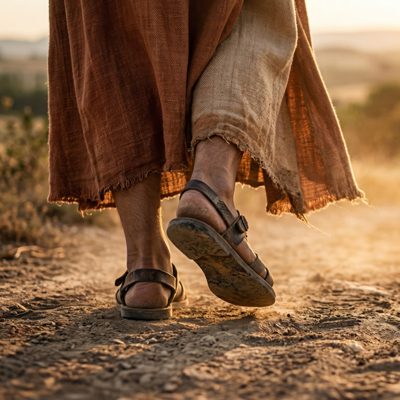
But then he turns and he’s the one to see the burning bush. He takes off his sandals. He’s standing on holy ground. And there in the presence of God, he asked the question, who am I? Why would Pharaoh listen to me? He was afraid they’d smell the popcorn on him.
But then he asked, “Who are you? Who do I tell Pharaoh sent me?” There is this connection between who God is and who we are. and standing there on holy ground, taking off his sandals, he discovered who he was as a child of God and called to serve others. And as a result, Moses says, “Here I am.” That we find our lives by losing them.
And like Moses, we might hesitate, unsure about leaning into who we are as God’s children. We’re worried. Others will smell the popcorn on us.
There’s this wonderful story about a monk who was asked a question, perhaps the question we would all ask if we ever met a monk. The monk was asked, “What do you all do all day in the monastery?” We might picture halos and hallelujahs, but the monk said, “We fall and we get up. We fall and we get up. We fall and we get up again.”
Finding our lives on the holy ground of God’s presence means letting go of perfection. We simply lean into what it means to be children of God, listening to the life of Jesus, and resting our lives in the love of Christ.
And one way that we return to that holy ground, seeing that burning bush and taking off our sandals is through prayer. And when we think about prayer, we might imagine someone down on their knees, eyes closed. All of the children’s books that I was read as a child that were about prayer, it was someone kneeling beside the bed, eyes closed in prayer.
And that is one way to pray. But whether we’re standing, sitting, or kneeling, eyes opened or eyes closed, we are always surrounded by God’s presence, standing on holy ground. And God is always listening to us. But from time to time, we might try praying while kneeling.
Eugene Peterson once wrote, “On my knees, I’m no longer in a position to flex my muscles, strut or cower, hide in the shadows or show off on stage. I set my agenda aside for a time and become still, present to God.”
We don’t have to flex our muscles or hide in the shadows. We don’t have to defend who we are or hold back part of ourselves. We can stand on the holy ground of God’s presence, taking off our sandals, and living fully into what it means to be children of God. Amen.