
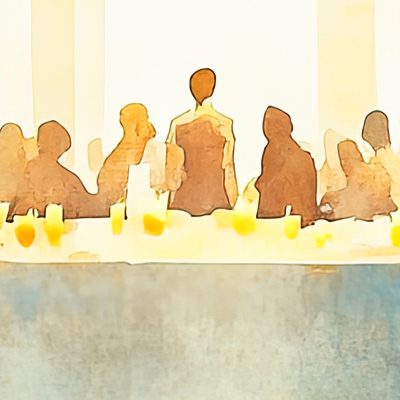
Jesus through the parables invites us to see this world as the kingdom of heaven where it is on earth as it is in heaven. Like this king planning a wedding banquet for his son, he sends out all these invitations, but nobody RSVPs. So he sends them out again.
This time, on the back of the invitation, he shares the menu. Braised oxtail with red wine, fresh root vegetables and herbs, five-star dining. But everybody makes light of it. Oh, I’ve got some work to do on the farm. Long to-do list at the business. People had other things to do.
To say the least, the king was outraged. So this time he sends these invitations out to Main Street to give them to anyone and everyone. Didn’t matter if you had a good reputation. Didn’t matter if you had a bad reputation. Everyone was invited.
And there are parts of this parable which trouble us deeply. An outraged king, angry and resentful. Invitations that are rejected, mistreated slaves, those who delivered the invitations, and then that one wedding guest who was thrown out because he wasn’t wearing a proper wedding robe.
The primary emphasis of this parable is the invitation list. That it might be the very first street ministry, just going out on Main Street and talking to anyone and everyone.
And in a similar parable, the disciples are distraught because they look out on the field and wheat and weeds are growing together and they get all nervous and anxious and they ask Jesus, should we go out and pull up all the weeds? And Jesus says, no, because without realizing it, you may not be able to tell the difference and you may pull up some of the wheat with the weeds.
That perhaps the readers of the Gospel of Matthew had this overarching concern about who was good and who was not and who should be invited. And Jesus tells this parable calling them and us to invite everyone.
As Tom Long writes, sometimes purity is in tension with mission.
But as we have all heard, we don’t want to be so heavenly minded that we are no earthly good. It’s easy to confuse all of this because as Jesus says, faith is a narrow path. But we must never forget that that narrow path begins with a very wide door.
That we might be tempted to narrow the doorway because of the narrow path. But this turns out to be more about control.
And Aaron will teach us, control is quite dangerous because the people were upset. They were having to wait on Moses who was delayed on the top of Mount Sinai and they got stir-crazy.
So Aaron tries to step into the shoes of leadership and says, well, bring me all your gold rings. And he melted them down and molded them into this golden calf. Strangely enough, Aaron tries to say, let’s plan a festival for the Lord.
But this golden calf theology turns out to be more about controlling God. That if God’s going to keep us waiting on Moses, we’re just going to come up with a life hack to get to God quicker.
God will never be domesticated. It’s why we cannot narrow the doorway, controlling who is invited and who is not. That even if we try to narrow the invitation list based on what we think is good, all we do is end up cutting ourselves off from others.
Years ago at Princeton Theological Seminary at a chapel service, all of the faculty and the students stood up to sing that beautiful, powerful hymn, A Mighty Fortress Is Our God. And for their convenience, the text was printed in the bulletin, but there was a typo.
So when they got to that last and final stanza, when they’re supposed to sing, let goods and kindred go this mortal life also. You know, we give all that we have, even our mortal lives to God. Instead, it said, let goods and kindred go this moral life also.
Kinda funny for a bunch of seminary professors and future ministers. Letting go of all we have and our morals?
That we would never say that our morals are unimportant. If those rules become twisted, they might end up being more of an effort to control God than to let God lead us.
Because love is not clinical. It is not sterile. It’s more like field medicine where we lean more into faith and not into sight.
That in many ways it’s the difference between a set table ready for the guests to arrive and a full table with guests sitting all around. That a set table is pristine and perfect. You want to take a picture of it and post it online. A full table, though, is far messier. More disarray, maybe a few spills. But it’s also full of more joy.
As Jürgen Moltmann writes, mission happens through community, eating and drinking. Hope is eaten and drunk. At a full table, there’s less elbow room. There’s more noise. It also looks more like the kingdom of heaven.
There’s this old Jewish saying about the coming of the Messiah, that the Messiah can only come once all the guests have taken their place around the table. And that is only possible when there is a wide door for that narrow path.
For the vulnerable, the poor, the hungry, the grieving, the hurting, the hopeless, the burdened, the guilty, the ashamed, the different, the other, the ignored, the forgotten, the rejected, the overlooked.
It has been 25 years since I visited a church. Now, I’ve been to church. I have witnesses. I’ve even gone to a couple new churches. But it’s been 25 years since I wandered into the back of a sanctuary hoping I didn’t sit in anyone’s pew, and sat down and opened the bulletin and glanced around the room, not knowing anybody, and thought to myself, I wonder if this is a good place for me.
And there are many wonderful reasons to visit and join a church that we find the worship service meaningful, providing stillness and transcendence, refuge and hope. That we sense a kinship with the people, a place where we can ask questions and learn from others and grow in our faith.
That we meet people who will care for us, helping us raise our children, encouraging us through all the seasons of life and willing to share their joys and challenges with us as well. Many reasons to visit and join a church.
But if I was to visit a church today… one thing that I would look for. This is why I do it. to that narrow path. God is all. able to surprise us.
Because it leads to deep and abiding community, where unlikely friendships take place, where people show up for one another, where we keep striving to forgive one another, and where we are sent out into this world not with a defensive posture, but with open hands to share the goodness of grace.
Amen.